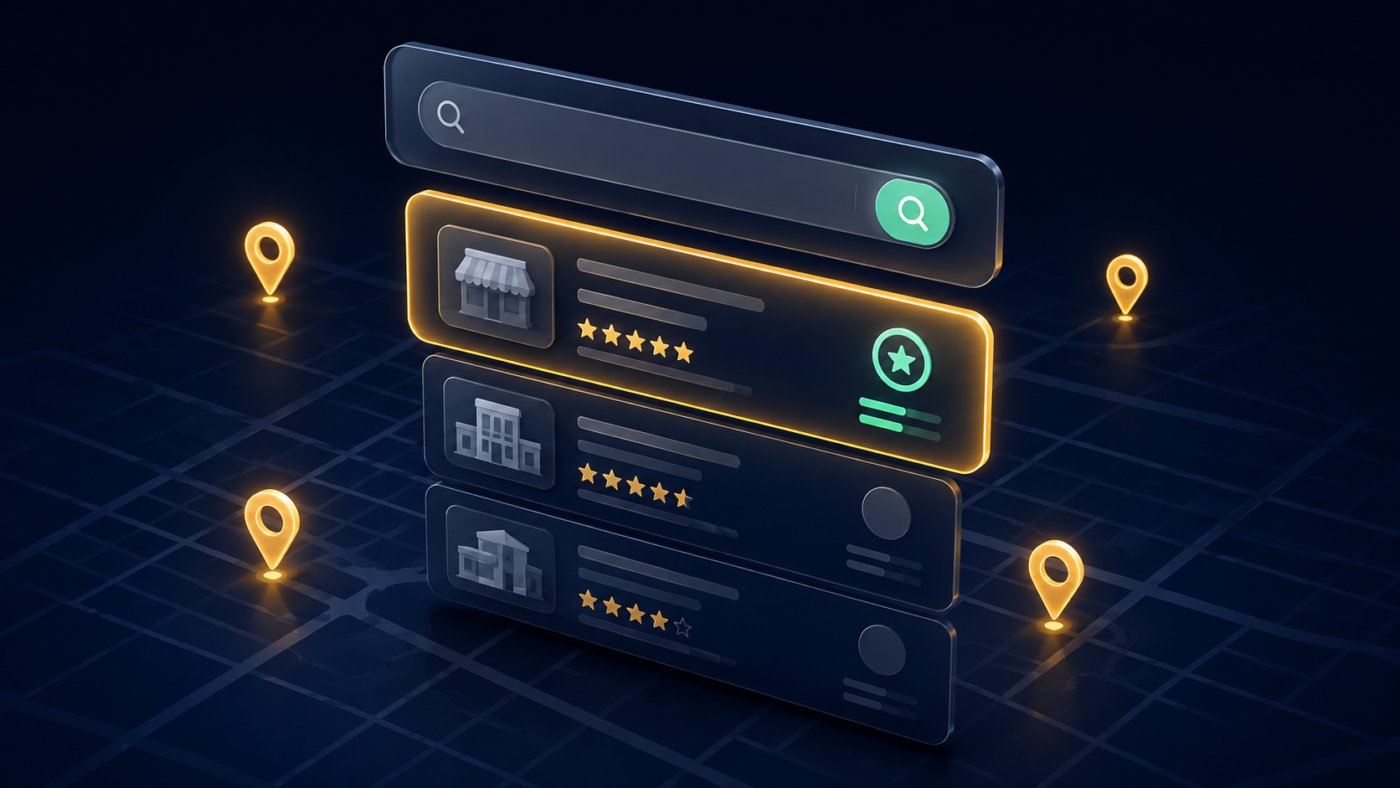
To rank in the Google map pack, you need three things working together: a correctly categorized and fully completed Google Business Profile, consistent business information across the web, and enough local relevance on your own website that Google trusts you for the search. Most US businesses that are stuck outside the top three are failing on the first one, and it is usually the cheapest to fix.
I have been doing local SEO since 2011, and I run Google Business Profiles for clients in Florida, Ohio, Illinois, Washington, Nevada and half a dozen other states. The pattern almost never changes. A business owner tells me their rankings dropped, or that they have never ranked at all, and they assume the answer is more backlinks or more content. Then I open their profile and find the primary category is wrong, the service area is set to a 200 mile radius, and the address on their Yelp listing does not match the one on Google.
This guide walks through what actually moves the map pack in 2026, in the order I do the work for paying clients. No theory, no guarantees, and nothing that will get your profile suspended.
What the map pack is, and why it decides your phone calls
The map pack, also called the local pack or the 3-pack, is the block of three business listings with a map that appears near the top of Google for searches with local intent. If somebody searches “roofing company near me” or “dentist in Tampa”, the map pack usually sits above the regular blue links.
It matters more than your website ranking for one blunt reason: the map pack has a call button. Somebody who taps that button is on the phone with you in two seconds without ever visiting a website. For service businesses, this is where the majority of local search revenue comes from.
There are three positions. Not four, not ten. That is the entire competition, and everybody below position three is fighting for the small percentage of people who tap “More places”.
The three things Google actually weighs
Google has stated publicly that local ranking comes down to relevance, distance and prominence. It is worth understanding what each one means in practice, because two of them you can influence heavily and one you cannot influence at all.
- Relevance is how well your profile matches what the person searched. This is driven by your categories, your services, your business description and the content on your website. You control this completely.
- Distance is how far you are from the searcher, or from the location in their search terms. You cannot control this. It is why you rank well within a few miles of your address and poorly across town.
- Prominence is how well known and well established your business appears to be. Reviews, citations, links, mentions and general web presence all feed into it. You influence this over months, not days.
Because distance is fixed, everything you can actually do falls into relevance and prominence. The businesses that beat you across a wider area are not closer to more people. They are simply more relevant and more prominent, which lets them win searches further from their door.
Step 1: Fix your primary category
Your primary category is the single most under-rated lever in local SEO, and it is the first thing I check on every audit.
Google treats the primary category as the strongest signal of what your business is. If it is wrong, you are invisible for the search that actually converts, no matter how good the rest of your profile is. Changing it can move rankings within days, which is unusual in SEO where most changes take weeks.
Here are the mismatches I see most often in US markets:
| Business type | Category I usually find | Category that should be primary |
|---|---|---|
| Practice focused on veneers and whitening | Dentist | Cosmetic dentist |
| Clinic doing injectables and laser | Beauty salon | Medical spa |
| Storm damage and re-roofing company | Contractor | Roofing contractor |
| Local household movers | Storage facility | Moving company |
| Garage door repair company | Contractor | Garage door supplier |
| Firm handling car accident claims | Lawyer | Personal injury attorney |
How to find the right one: search your main keyword in an incognito window, open the profiles of the three businesses currently sitting in the map pack, and look at the category displayed under their name. If all three share a category and you do not have it, that is your answer.
Add secondary categories too, but be disciplined. Every secondary category you add dilutes the others slightly. Three to five relevant ones is usually right. Twenty is not a strategy, it is noise.
Step 2: Complete every field on the profile
Google rewards completeness, and most profiles are half empty. Work through all of it:
- Services. Add every service you offer as a separate entry with its own description. This is free keyword real estate that most competitors leave blank.
- Products. Even service businesses can use this. A roofer can list “asphalt shingle replacement” and “emergency tarping” as products with photos and prices.
- Business description. 750 characters. Write it for a human, mention what you do and where you do it, and do not stuff keywords into it.
- Hours, including holiday hours. Profiles marked “Open now” get more clicks, and Google notices when your hours are stale.
- Attributes. Wheelchair accessible, appointment required, veteran owned, women owned, free estimates. These feed filtered searches that your competitors are not appearing in.
- Photos. Real photos of your premises, team, vehicles and completed work. Upload steadily rather than dumping forty at once.
- Q and A. You can ask and answer your own questions. Seed it with the five things customers actually ask before booking.
One important warning: do not put keywords in your business name field. “Tampa Emergency Plumber | Joe’s Plumbing” may bump you temporarily, but it is a direct guideline violation and it is the single most common cause of suspension I see. It is not worth it.
Step 3: Clean up your NAP and build citations
NAP stands for name, address and phone. Google cross-references your business details across the web to confirm you exist and are where you say you are. When it finds conflicting versions, confidence drops and so do rankings.
Search your business name and phone number in quotes and see what comes back. You will usually find an old address from a previous office, a phone number you stopped using two years ago, or a listing created by an employee who has since left. Every one of those needs correcting or claiming.
Then build out the citations that matter for US businesses: the major aggregators, the big general directories, and the industry-specific sites for your vertical. A contractor should be on the trade directories that homeowners actually use. A law firm should be on the legal directories. Fifteen well-chosen citations beat two hundred automated submissions, and the automated ones often introduce the exact inconsistencies you are trying to remove.
Step 4: Reviews, at the right pace
There is no magic review count. What matters is having a review profile comparable to or better than the three businesses currently ranking above you, and receiving new reviews steadily rather than in bursts.
Go look at your top three map competitors, note their review count and average rating, and that is your realistic target. If they average 80 reviews at 4.7 stars and you have 12, you know the size of the gap.
Three things I have found matter more than raw count:
- Reviews that mention the service and the area. A review saying “replaced our roof in Brandon after the storm” carries more weight than five stars with no text. You can encourage this by asking a specific question rather than saying “please leave a review”.
- Replying to every review. Including the negative ones, calmly. It is a visible activity signal and it is one of the few things you fully control.
- Steady pace. Twenty reviews arriving in one week looks manufactured to Google’s spam systems. A handful every week for a year is far more effective and far safer.
I do not write, buy or arrange reviews for any client, in any market. Beyond the fact that it violates Google’s policies and FTC rules on endorsements, review filters have become good enough that purchased reviews frequently get stripped out along with some of your genuine ones.
Step 5: Post to the profile every week
Google Posts do not directly rocket you up the rankings, but an active profile is a healthy profile, and posts occupy space in your listing that competitors leave empty.
Post about actual things: a job you completed, a seasonal offer, a new service, a common question answered. Include a photo and a call to action. I publish around twenty posts a month for clients on the Google Business Profile plan, and the measurable effect usually shows up in profile interactions and website clicks before it shows in position.
Step 6: Your website still matters
People assume the map pack is decided entirely inside the Google Business Profile dashboard. It is not. Google reads your website to work out how relevant you are for a given search.
The work that matters most:
- A real page for each service. Not one page listing twelve services in bullet points. One page per service, each genuinely written.
- Location pages that are not duplicates. If you serve five cities, each city page needs content specific to that city. Swapping the city name in an otherwise identical template is a well-known pattern and it does not work.
- Schema markup. LocalBusiness, Service and FAQ schema so search engines and AI assistants can extract your details as structured facts instead of guessing.
- Speed and Core Web Vitals. Mostly a user experience issue, but a slow site on mobile loses the customer even when the ranking is fine.
- Your NAP in the footer, matching your Google profile exactly, and an embedded map on your contact page if you have a physical storefront.
Step 7: Track with a geo-grid, not a single rank check
If you check your ranking by searching your keyword on your own phone, sitting at your own desk, you are getting the most flattering possible answer. You are standing at your business address, so proximity is doing all the work.
A geo-grid scan checks your position from dozens of points across your service area and shows the result as a map. Suddenly you can see that you are number one within half a mile, number seven two miles out, and nowhere at all on the other side of town.
That map is the single most useful diagnostic in local SEO, because it turns a vague goal into a specific one. You stop asking “how do I rank better” and start asking “how do I extend my number one area north into these ZIP codes”.
What does not work, and what gets you suspended
A short list, because avoiding these is worth more than most of the tactics above:
- Keywords in the business name. The most common suspension trigger there is.
- A virtual office or coworking desk listed as a staffed location. Google requires a location staffed during your stated hours.
- Creating multiple listings for the same business to cover more cities. They get merged or removed, and it can take the original down with them.
- Buying reviews. Covered above.
- Automated citation blasts. They create inconsistencies faster than they build authority.
- Changing your name, address and category all in one week. A pile of simultaneous edits looks like a hijacking attempt and often triggers a review.
If your profile is already suspended, the important thing to understand is that appealing without fixing the underlying violation is the most common reason reinstatements fail. Diagnose the cause, correct it, gather your licensing, utility bills and signage photos, and then appeal.
How long this takes
Anybody quoting a fixed number of days for a number one position is guessing, because proximity between the searcher and your address is a factor no consultant controls. What I can tell you is the order things move in, which is remarkably consistent:
| Timeframe | Work being done | What you should see move |
|---|---|---|
| Weeks 1 to 2 | Category fix, profile completion, technical errors | Impressions and profile views |
| Weeks 3 to 6 | NAP cleanup, citations, review system, posts | Direction requests and website clicks |
| Months 2 to 3 | Service pages, schema, local links | Phone calls and form submissions |
| Months 3 to 6 | Content depth, review volume, authority | Ranking positions stabilizing |
Competition changes the timeline considerably. A garage door company in a Phoenix suburb moves faster than a personal injury attorney in Los Angeles competing against firms spending six figures a year.
The 2026 addition: getting named by AI
Something genuinely changed in the last two years. A meaningful share of people looking for a local business now ask ChatGPT, Gemini, Claude or Perplexity for a recommendation instead of searching Google, and Google’s own AI Overviews sit above the map pack for many queries.
These systems recommend businesses they can find described clearly and consistently across sources they trust. In practice, three things move the needle:
- Answer-first content. Write pages that answer the exact question somebody would ask out loud, with the direct answer in the opening sentence rather than four paragraphs down. This entire article is written that way deliberately.
- Complete schema markup. So a machine extracts your services, prices and service area as facts rather than inferring them from prose.
- Consistent third-party description. Your Google Business Profile, your directory listings and your own site should describe your business the same way. Contradictions make you a risky recommendation.
It is measurable, too. Rather than only tracking positions, I track how often a client gets named across a fixed set of prompts. That is a different metric from ranking, and it is becoming a more important one every quarter.
Frequently asked questions
How long does it take to rank in the Google map pack?
Expect the first measurable movement in four to six weeks and stable positions on your main keywords in three to six months, depending on how competitive your category and city are. Profile views and impressions shift first, then direction requests and clicks, then calls, with ranking positions settling last.
How many Google reviews do I need to rank in the top three?
There is no fixed number. What matters is a review profile comparable to or better than the businesses currently sitting in the map pack for your keywords, and new reviews arriving steadily rather than in bursts. Check your top three competitors’ counts and ratings, and that is your realistic target.
Can I rank in the map pack without a physical address?
Yes, if you travel to customers. Set your profile up as a service area business, hide your address, and define the cities or ZIP codes you actually serve. Do not set a 200 mile radius hoping to cover more ground, because an unrealistically large service area weakens your relevance everywhere inside it.
Does my primary category really matter that much?
Yes. It is the strongest single signal Google uses to decide what your business is, and a wrong category makes you invisible for your most valuable search regardless of how good the rest of your profile is. It is also one of the few changes that can move rankings within days rather than weeks.
Why do I rank number one near my office but nowhere across town?
That is proximity, which is a ranking factor nobody controls. The way to expand the area where you rank is not tricks but depth: more reviews mentioning your services and neighborhoods, more genuinely local content on your website, and more citations and local links than the profiles currently beating you further out.
Do I need to hire a Local SEO expert to do this?
Not necessarily. Everything in this guide is work a business owner can do, and if your profile only needs a category fix and some review activity, you should just do it. Hiring makes sense when the competition in your market is organized, when you do not have several hours a week to spare, or when the work needs to continue every month rather than once.
Where to start this week
If you do nothing else from this article, do these three things. Open your Google Business Profile and check your primary category against the three businesses currently ranking above you. Search your business name and phone in quotes and fix any listing showing an old address or number. Then ask your next five happy customers for a review, and ask them to mention the specific service and the area.
Those three actions cost nothing and fix the problems I find on the majority of profiles I audit.
If you want a second pair of eyes on it, I offer a free audit covering your website, your Google Business Profile and your three closest map competitors, usually returned within a day. There is no sales call and no obligation, and if your profile only needs one small fix I will tell you that rather than sell you a retainer. Send your website and city on WhatsApp, or read more about how the Local SEO and Google Business Profile services work and what they cost each month.